The hidden buyer behind remodeling demand
I’m coming back from DC, where I spent time with some of the top homebuilders and remodelers in the country.
Homebuilding revenue is slowing with the economy, buyers are constrained, and a lot of builders are feeling that pressure.
Remodeling felt different.
Not easy. Not booming, but steadier.
That matches what the data says. NAHB says home improvement has grown from about one-third of residential construction spending in 2007 to roughly 45% by Q3 2025. That means remodeling and home improvement are taking up a much bigger share of the residential construction market than they used to.
New homes, custom homes, prefab, multifamily, and everything else essentially make up the other half.
The more interesting part is who has the buying power.
Younger buyers are still in the market, but they’re under a lot of pressure. Homes are expensive. Rates are higher than people got used to. First-time buyers are older than they used to be, and many need help to get in the door.
Baby boomers, on the other hand, have a lot of the housing money. They have home equity. They have savings. They often have a reason to spend money on the house they already own, or on the house their family is trying to make work.
NAHB’s Eye on Housing reported that baby boomers had the largest generational share of remodeling expenditures in 2024, at about $254 billion, or 38% of total remodeling spending.
So the short version is this: young people are struggling to buy homes, but baby boomers are buying remodels.
Aging in place is the obvious part
Here’s a horrible picture I took in one of the meetings:
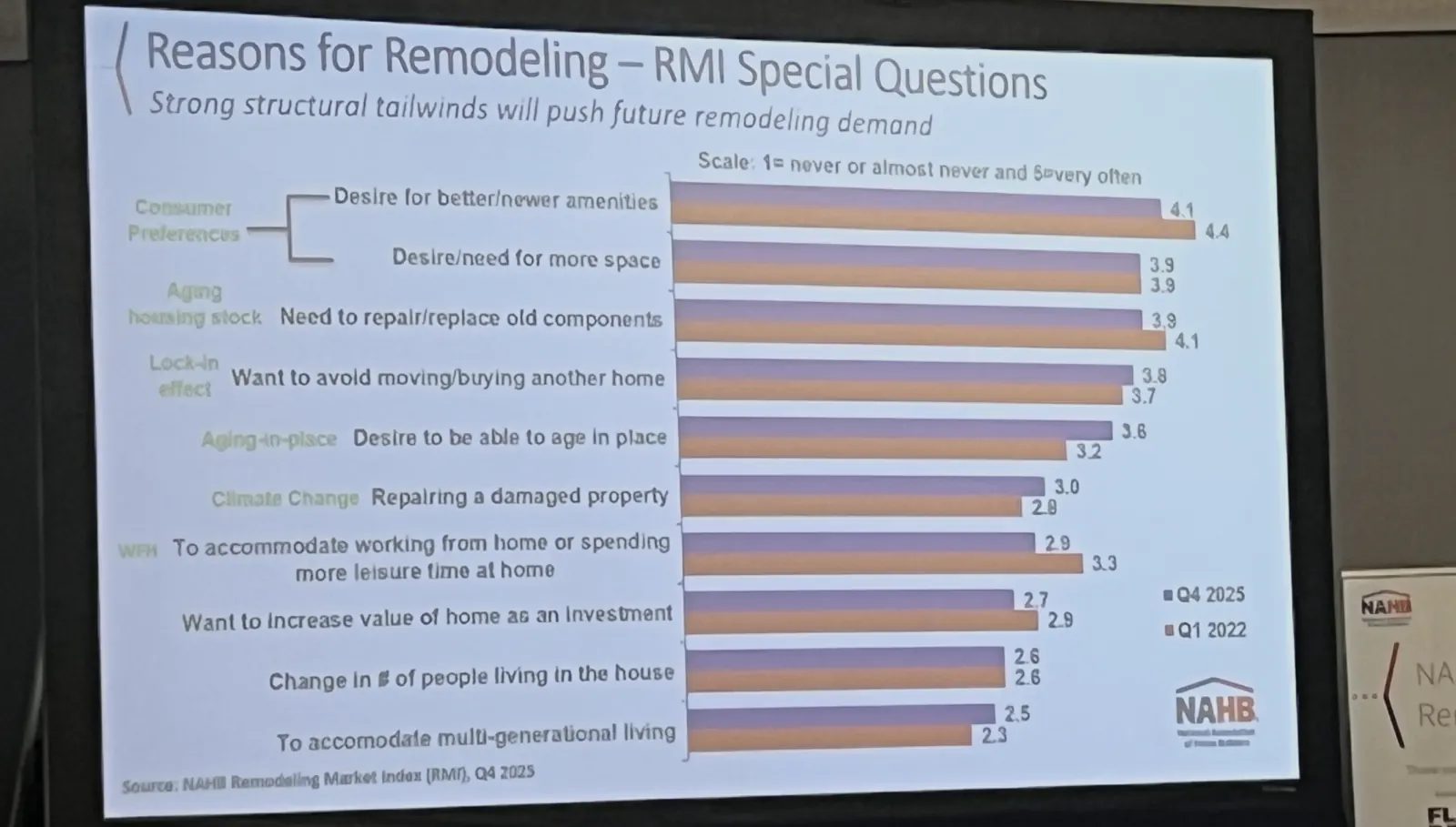
One of the big reasons was aging in place.
That is not surprising. More people want to stay in their homes longer. More adult children are thinking about whether a parent can live safely without moving into a facility. More homeowners are realizing the house that worked at 52 may not work the same way at 72.
NAHB says 73% of remodelers report more requests for aging-in-place work over the past five years. That tracks with what remodelers have been saying for a while. Wider entries, main-level living, safer bathrooms, better lighting, fewer stairs, easier movement through the house. These are not fringe requests anymore.
But if remodelers only talk about aging in place as a list of safety features, they miss the bigger story.
Aging in place is not always just an older homeowner staying in the same house. Sometimes it is a family redesigning one home so independence, care, privacy, and proximity can all coexist without making everyone miserable.
That’s where the conversation in DC got more interesting.
The sharper angle is multigenerational living
At the bottom of that slide was another reason people remodel: accommodating multigenerational living.
We talked about this a lot.
Parents are moving back in with their adult kids. Adult kids are trying to figure out how to help aging parents without creating a bad living situation for everyone involved. Families are looking at the cost of housing, the cost of care, and the reality of getting older, and deciding that one house may need to do more than it used to.
The part that caught my attention was not just that families are doing this. It was who may be paying for it.
The economist in the meeting, and several remodelers in the room, talked about parents funding remodels so they can move in with their kids.
That is not a national statistic I’m going to pretend is fully quantified. It was an in-room pattern from people seeing projects up close. But it changes the way remodelers should think about the customer.
The person who owns the home may not be the only buyer.
The person who funds the project may not be the person who filled out the website form.
The person who cares most about privacy may not be the same person who cares most about resale value.
The person who will live in the new suite may not be the person making daily decisions with the remodeler.
That is a different marketing problem than “homeowner wants nicer kitchen.”
It’s also not isolated to remodeling. NAR has reported that 22% of first-time buyers used a gift or loan from a friend or relative for a down payment. In another survey cited by NAR, 74% of parents with children at home said they would consider or had started planning to help their kids buy a home someday.
The family balance sheet is showing up in housing decisions more often. Sometimes that means parents helping kids buy. Sometimes it means parents helping remodel. Sometimes it means one house has to serve three generations with very different needs.
The buyer may not be one person anymore
Most remodeling websites still write to one clean persona: the homeowner. Usually that homeowner is imagined as a couple in their 40s or 50s who wants a better kitchen, a larger primary suite, a nicer bathroom, or more space for kids.
That buyer still exists, but a lot of projects are not that simple.
A basement remodel might really be about creating a private space for a parent. A main-level suite might be about avoiding stairs later, or giving an aging family member independence now. An addition might be about letting a grandparent move in without turning the house into a sitcom premise. An ADU might be about family care, rental flexibility, or a future inheritance plan.
The better question is not just “Who owns the home?”
It is “Who is funding the project, who will live in the space, who is worried about safety, and who is trying to keep the family close without driving everyone insane?”
That sounds less tidy than a single buyer persona. It’s also closer to how people actually make these decisions.
A main-level suite is not just a feature. It may be a family plan.
A bathroom remodel is not just tile, glass, and fixtures. It may be the difference between a parent staying independent and needing more help.
An addition is not just square footage. It may be a way to make privacy, care, and shared family life all fit under one roof.
That should change how remodelers talk about these projects.
What this should change on remodeler websites
I said in the video that I’ll definitely be adjusting a couple web pages around this. I meant it.
If you’re a remodeler, this is worth looking at on your own site too.
Many remodeling decisions now involve more people, more money sources, and more long-term family planning than the average service page admits.
A few practical places to look:
Addition pages. If your addition page only talks about “more space,” you may be underselling the real reason people care. Add language around main-level suites, private living areas, family flexibility, visiting parents, adult children, grandchildren, and future needs.
Whole-home remodeling pages. A whole-home remodel is often about making a house work for the next chapter of life. That could mean aging in place, but it could also mean creating better zones for family members who need independence and connection at the same time.
Basement and lower-level pages. These pages often focus on entertainment space, guest rooms, or rental potential. Those are useful. But for some families, the basement is part of a multigenerational plan. Talk about privacy, storage, bathrooms, entries, sound control, and how the space will actually be used.
Aging-in-place pages. Don’t make these sound like a medical equipment catalog. Safety matters, but people do not only want to be safe. They want to keep dignity, independence, comfort, and some sense that their house still feels like home. The language should respect that.
Project galleries. If you have relevant projects, label them in a way that helps people see the family use case. “Main-level suite for future aging-in-place” is more useful than “primary suite addition.” “Private lower-level living space for extended family” tells a clearer story than “finished basement.”
FAQs. Add questions for adult children and parents making decisions together. Things like:
- How do we plan a remodel if a parent may move in later?
- Can we make a space private without making it feel separate from the family?
- What should we consider for accessibility before we actually need it?
- How do we talk through budget when more than one family member is contributing?
- Can this project support aging in place and resale value?
These are real questions people are already asking around kitchen tables. If your website answers them before the sales call, you feel more useful before you ever speak to the prospect.
The marketing has to match the decision
This is where a lot of remodeler marketing falls short.
It talks about services, but not the family situation behind the service.
It talks about features, but not the tension the project is supposed to solve.
It talks to “the homeowner,” but the decision may involve an adult child, a parent, siblings, a spouse, and the person helping fund the project.
People are not only buying a nicer house. In a lot of cases, they’re buying time, flexibility, privacy, safety, and a better way for the family to handle the next stage of life.
That is a much stronger message than “beautiful craftsmanship and attention to detail,” mostly because every remodeler says that and most homeowners have learned to float right past it.
The remodelers who speak clearly to the actual family decision will have an advantage. Not because the data makes a cute talking point, but because the market is already moving this way.
Builders in DC sounded cautious. Remodelers sounded steadier. And underneath that difference was a buyer shift worth taking seriously.
The next remodeling customer may not just be the person living in the house today. It may be the parent helping fund it, the adult child trying to plan ahead, or the family trying to make one home work for more than one generation.
That should probably show up on the website.
Sources and notes
- Mitch’s DC meeting notes and video script, 2026-06-13.
- NAHB, “2026 Housing Outlook: Ongoing Challenges, Cautious Optimism and Incremental Gains.” Home improvement share of residential construction spending rose from 33% in 2007 to 45% in Q3 2025. https://www.nahb.org/news-and-economics/press-releases/2026/02/2026-housing-outlook-ongoing-challenges-cautious-optimism-and-incremental-gains
- NAHB, “NAHB Expects Remodeling Growth in 2026 and Beyond.” Aging housing stock, home equity, mortgage lock-in, and aging-in-place are cited as remodeling tailwinds. https://www.nahb.org/news-and-economics/press-releases/2026/02/nahb-expects-remodeling-growth-2026
- NAHB Eye on Housing, “Who Drives Remodeling Spending?” Baby boomers spent about $254B on remodeling in 2024, about 38% of total remodeling expenditures. https://eyeonhousing.org/2026/05/who-drives-remodeling-spending/
- NAR, “Parents Are Saving Up to Help Their Kids Buy a Home.” Includes NAR first-time buyer down payment gift or loan data and Northwestern Mutual parent planning data. https://www.nar.realtor/news/real-estate-news/parents-are-saving-up-to-help-their-kids-buy-a-home